art of the steal?
The plane slowed and leveled out about a mile aboveground. Up ahead, the Viennese castle glowed like a fairy tale palace. When the pilot gave the thumbs-up, Gerald Blanchard looked down, checked his parachute straps, and jumped into the darkness. He plummeted for a second, then pulled his cord, slowing to a nice descent toward the tiled roof. It was early June 1998, and the evening wind was warm. If it kept cooperating, Blanchard would touch down directly above the room that held the Koechert Diamond Pearl. He steered his parachute toward his target.
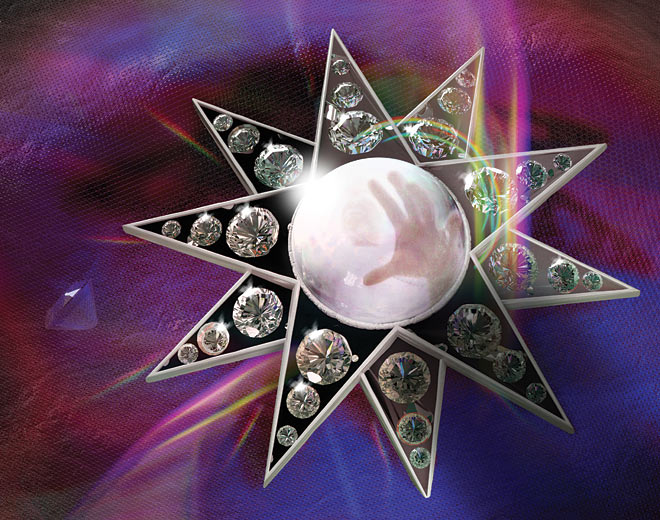
A couple of days earlier, Blanchard had appeared to be just another twentysomething on vacation with his wife and her wealthy father. The three of them were taking a six-month grand European tour: London, Rome, Barcelona, the French Riviera, Vienna. When they stopped at the Schloss Schönbrunn, the Austrian equivalent of Versailles, his father-in-law’s VIP status granted them a special preview peek at a highly prized piece from a private collection. And there it was: In a cavernous room, in an alarmed case, behind bulletproof glass, on a weight-sensitive pedestal — a delicate but dazzling 10-pointed star of diamonds fanned around one monstrous pearl. Five seconds after laying eyes on it, Blanchard knew he would try to take it.
via Wired.
vishy
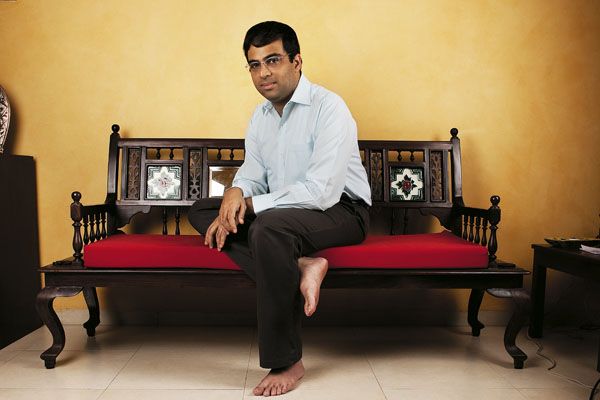
In 1991, we heard of a young Indian lad from India called Vishy Anand. Viswanathan was a roller coaster on the tongue and the name Vishy, or Bishy in Spanish, stuck. We heard of this boy, from a country that didn’t have much of a chess culture then, take on the great Soviet chess system. What made everyone sit up and notice was that this typical teenager played chess at a pace that was till then not imaginable. He had no coach, no trainer and in many ways was a maverick. He had just won the prestigious Reggio Emilia (The strongest chess event till that time) ahead of Karpov and Kasparov, even defeating the latter in his quest. Having met all the great chess players and many of the World Champions, this Indian boy intrigued me.
When I first met Vishy, he was dressed in baggy jeans, big white sports shoes, a walkman to his ears on which he listened to what he called the Cranberries and Pet shop boys. For an ear trained in Brahms and Beethoven, the sound of this music just seemed like Boom Boom Boom! He would always, and still does, stuff his hands in his trousers and walk quickly chuk chuk chuk back and forth in Linares. We marvelled at the fact that someone who looked like a teenager could be such a fantastic player.
He played Alexander Beliavsky and the boy took 16 minutes. He never sat on the board. When the clock was pressed and it was his turn, he would immediately make his move and start wandering. “Today,” I tell him, “Vishy, you are a mature man, you actually think before you play” …. He says, “Yes Maurice, age you see.”
During that game, we were shocked. We had never seen anyone play so fast and so correctly. So after the game, Nieves and myself met him at dinner and I told him, “Joven [young man], tomorrow you play Karpov, you can’t play in this swashbuckling style, you have to play slowly, not in 16 minutes.” He said, “Sure Mr. Maurice”, and added, “OK I will play slowly. How about 17 minutes?” In that moment I knew I had found a special person on whom I was going to keep an eye. Nieves said, “Beat Karpov for me.” And Vishy said, “Sure. If I do, I will take you to the best Chinese restaurant in town.” Vishy won and came out running to Nieves. He said, “It’s a date. Let’s go.”
via Forbes India.
metaphor
If only we could all grasp that this is always true of mediated communication in general...
Writing about science poses a fundamental problem right at the outset: You have to lie.I don't mean lie in the sense of intentionally misleading people. I mean that because math is the language of science, scientists who want to translate their work into popular parlance have to use verbal or pictorial metaphors that are necessarily inexact.
Here is where the art of science writing for the public truly lies. Choosing the proper metaphor can make all the difference between distorting science and providing an appropriate context from which nonscientists can appreciate new scientific findings and put them in perspective.
via WSJ.com.
diarmaid macculloch
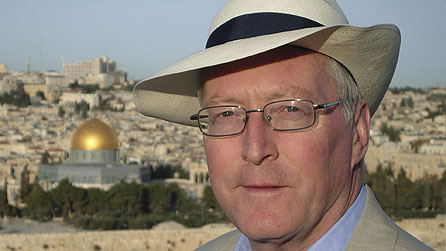
"I come from a clergy background," says Professor MacCulloch. "I've grown up with the Church and my father was a huge enthusiast for history. We talked history – quite naturally – as other families might talk football. And, so, it is a part of my being and the thing which I've always loved doing."
When asked how he and the production team went about beginning to shape this epic series, Professor MacCulloch, who studied history at Cambridge and began his research under famed historian Sir Geoffrey Elton, has a simple answer.
"Well, the most difficult thing is to get the big shapes and the big structures," he says. "And the boring answer is that I've spent my life thinking about those shapes. The thing that any teacher has got to do is provide the big structure so that we don't get bewildered by detail. And you've got to do two things with a very big story. The first thing is that you've got to tell it in the right order. But history is not quite like that – it's not that simple. It's got to have shapes within in it. Right from my very first job, in my early twenties, I got a sense that history needs to be taught in a compelling way, to be taught as stories, to be entertaining. You've got to engage emotions. The past is about the clash of human beings – their emotions, their fears and their joys. And, if you can get that across, then you give people a sense of what the shapes are."
via BBC.
mechanical turk's best & brightest
Christopher Mims, in technology review:
Amazon's Mechancial Turk is the ultimate in nearly anonymous outsourcing: any task that can be completed online can be accomplished by the combination of automated marketplace and human labor. Those who sign up to complete tasks - Turkers - are paid wages as low as pennies per chore to do everything from data entry to folk art.Mechanical Turk is designed to complete tasks that are easy for humans and hard for machines, such as categorizing or identifying the content of images. The problem for Amazon and all its imitators, however, is that machines are getting better at many tasks, while the humans on Mechanical Turk, for reasons I'll explore in tomorrow's post, are getting worse.
Recently, for example, researchers working at the online review site Yelp released a paper (pdf) on their experience matching thousands of Mechanical Turkers against a supervised learning algorithm.
The results weren't pretty: in order to find a population of Turkers whose work was passable, the researchers first used Mechanical Turk to administer a test to 4,660 applicants. It was a multiple choice test to determine whether or not a Turker could identify the correct category for a business (Restaurant, Shopping, etc.) and verify, via its official website or by phone, its correct phone number and address.
79 passed. This was an extremely basic multiple choice test. It makes one wonder how the other 4,581 were smart enough to operate a web browser in the first place.
via Technology Review.
saddam hussein's blood qur'an
Such a complex story...

It was etched in the blood of a dictator in a ghoulish bid for piety. Over the course of two painstaking years in the late 1990s, Saddam Hussein had sat regularly with a nurse and an Islamic calligrapher; the former drawing 27 litres of his blood and the latter using it as a macabre ink to transcribe a Qur'an. But since the fall of Baghdad, almost eight years ago, it has stayed largely out of sight - locked away behind three vaulted doors. It is the one part of the ousted tyrant's legacy that Iraq has simply not known what to do with.
The vault in the vast mosque in Baghdad has remained locked for the past three years, keeping the 114 chapters of the Muslim holy book out of sight - and mind - while those who run Iraq have painstakingly processed the other cultural remnants of 30 years of Saddam and the Ba'ath party.
"What is in here is priceless, worth absolutely millions of dollars," said Sheikh Ahmed al-Samarrai, head of Iraq's Sunni Endowment fund, standing near the towering minarets of the west Baghdad mosque that Saddam named "the Mother of All Battles". Behind him is the infamous Blood Qur'an, written in Saddam's own blood.
via The Guardian.
...till he was strong
From 2 Chronicles 26:
And he did what was right in the eyes of the Lord, according to all that his father Amaziah had done. He set himself to seek God in the days of Zechariah, who instructed him in the fear of God, and as long as he sought the Lord, God made him prosper.
and...
In Jerusalem he made engines, invented by skillful men, to be on the towers and the corners, to shoot arrows and great stones.
but wait...
And his fame spread far, for he was marvelously helped, till he was strong. But when he was strong, he grew proud, to his destruction.
you've got to read the whole chapter.